

What is repurposing?
Repurposing refers to the structural reuse of wind turbine components for a different function than its original use.
Components can be repurposed in entirety or in parts. For example, turbine foundations can become water storage units on farms and turbine blade can be turned into playparks.
This strategy offers a lot of space for creativity. Furthermore, repurposing involves checking, measuring, cleaning, and potentially cutting components into the required sizes before turning it into a new product.
While it will not be possible to repurpose all components, this is a good strategy to generate value alongside recycling. Repurposing can also generate high social value in communities. Finally, structural reuse saves carbon emissions for products that would otherwise be manufactured from scratch.
The description of this circular strategy comes from the University of Leeds. The industry example underneath is independent of the university and their researchers.
Decommissioned blades or nacelles will be repurposed into a new function such as a noise barrier and a micro home. These examples offer a circular solution for end-of-life composite components of wind turbines.
Blade–Made substitutes heavy industry materials like steel and concrete with decommissioned blades. This saves precious composite material from landfill or incineration while mitigating the need for production of heavy industry materials.
As frontrunner in the space of circular material use, Blade–Made helps shift the general mindset of society on how to deal with our resources and values.
Repurposing wind turbine blades reduces disposal costs for wind park developers, supports sustainability goals, opens new revenue streams, enhances brand reputation, and attracts eco-conscious investors and partners.
Blade–Made offers a full-service end-of-life solution for all composite components of a wind turbine: the blades and the nacelle.
Repurposiong solutions for large composite components
Introduction text: By repurposing the large composite components of wind turbines, blades and nacelles, Blade–Made shows how creative engineering, cross‑sector collaboration, and testing can turn wind energy’s materials into assets for the built environment and beyond.
Blade Barrier® and Nacelle Micro Home illustrate innovative repurpose examples. Each project takes a different turbine component and reimagines its potential: one transforms decommissioned blades into scalable infrastructure, while the other turns an end-of-life nacelle into a fully functional micro‑home.
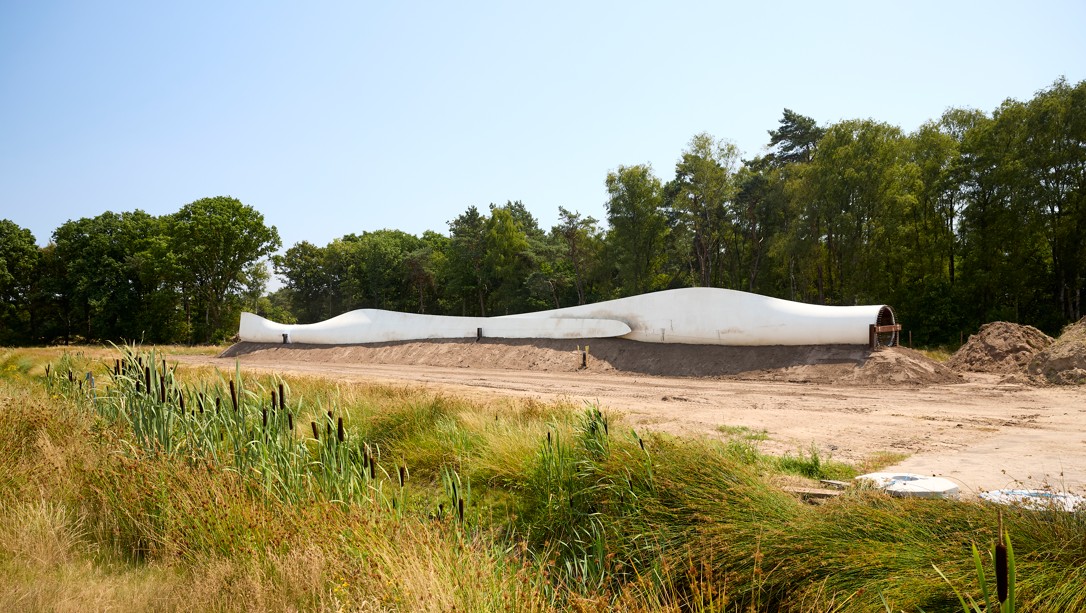
Blade–Made has identified noise barriers as one of the most promising large-scale applications for the repurposing of dismantled wind turbine blades. In this application, whole blades can be used as structural and functional building materials with minimal processing. A Blade Barrier® consists of wind turbine blades suspended in a foundation, with the underside enclosed by a slope of earth that can be planted with grass and wildflowers. It is possible to combine multiple blade types in a single screen. Thanks to this flexibility, screens of any length are feasible. Through a 60-meter trial installation in partnership with Rijkswaterstaat and Dura Vermeer, the performance of a Blade Barrier® has been tested on: 1. Manufacturability 2. Financial feasibility 3. Acoustic performance / noise reduction 4. Sustainability 5. Maintenance and safety Official results are scheduled to be published in Q4 2026. Interim reports show very promising results on all test categories.

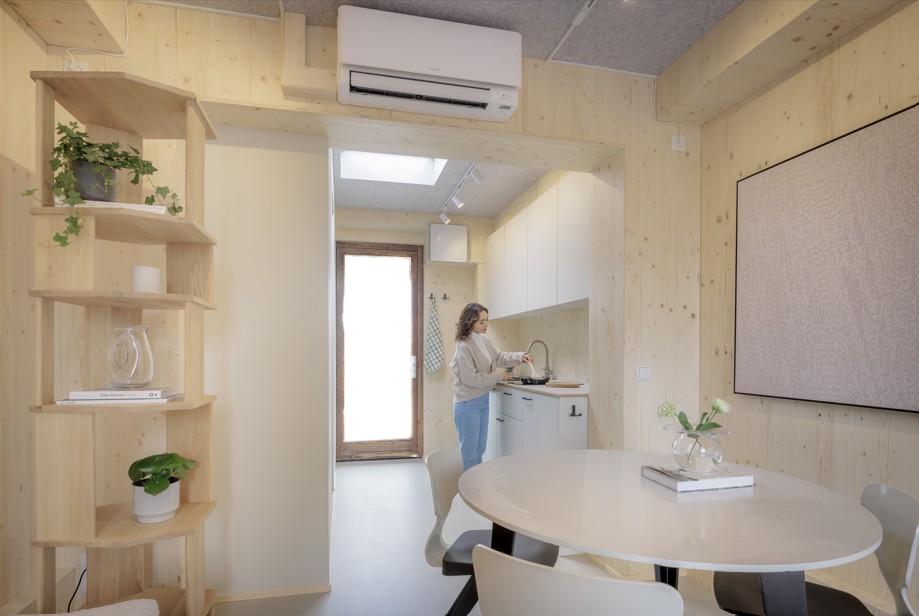
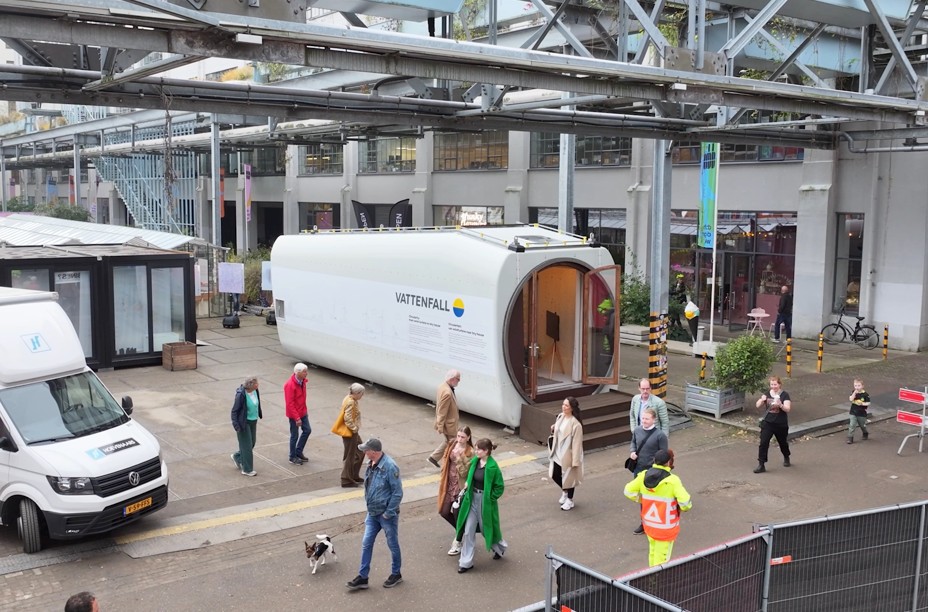
Often overlooked in the wind industries composite waste issue: the nacelle. Blade–Made has developed a compact living module from a decommissioned Vestas V80 nacelle. The ‘Nacelle Micro Home’ is a fully certified dwelling, fit for permanent residence under Dutch law. Developed in the context of Vattenfall’s “What If Lab” for the Dutch Design Week 2024, the Nacelle Micro Home is the world’s first example of a living solution made from a decommissioned nacelle. It serves as a prototype and the starting point for standardized and optimized production.
By proving the possibility of transforming a nacelle into a fully certified home, Blade–Made paved the way for the development of every other more simple solution like (animal) shelters, trekking cabins, storage units, etc…
See here the other Circular Strategies, which already provide a frontrunning showcase or are still available for new industry partners!

 Repurpose
 Refurbish
 Waste prevention
 Reuse
Reuse Dematerialise
 Remine